
Dear Kayla,
I’ve been following you for years and you are an inspiration. I just have not been successful in my weight loss journey to the satisfaction of my doctor and I’m now facing insulin shots for my diabetes. As we both know this is only going to make matters worse. He’s given me six months to get under 200 lbs. (I’m currently at 245). I know you are not a doctor and this is my problem but I’m stuck. The harder I try the more I self-sabotage. I love Jason Fung and he makes it sound so simple. And it really is or is it? Just stop eating. Simple is one thing, but there are no rehabs for sugar/carb addicts. People look down on you and make you feel ashamed for being fat and weak. I’m so depressed about all this all I do is sleep. I have my days and nights mixed up. I’m all alone and I’m really having a pity party! I don’t know how to get motivated to start again. I was close to 300lbs and I got down to 245, but it’s not enough. 245 is still fat and I’m still diabetic.
Signed,
Stuck in Florida and feeling sorry for myself!
Dear Stuck,
First of all, congratulations on dropping 55 pounds! That is an awesome achievement. It takes sustained effort and discipline to accomplish that. You must let the fact that you are making terrific progress sink into the very marrow of your bones. The reason it’s important is because right now it sounds like you’re feeling really discouraged, and discouragement is public enemy #1 on the weight loss journey.
Discouraged people tend to quit. And that’s the thing that leads to weight loss failure. You just need to keep going. You can do this. You’re already past the half-way point to being under 200. Whenever you feel discouraged, I want you to say out loud, “I’m over half-way there! I can do this!” Say it with emotion and conviction, even if you have to pretend at first.
Now, let’s address your concerns. #1: Yes, weight loss is simple. If you eat fewer calories than your body needs, you will lose weight. We all know that if we eat too much we’ll gain weight, or if we spend more than we make, we’ll be broke. And yet, 73.6% of Americans are overweight, and 78% live paycheck to paycheck. In other words, this is not a knowledge problem. It comes down to behavior. And behavior around food is tricky because food isn’t just food.
Food gives your body calories, yes. But it’s also tied up with our culture in other ways. Major life events, both happy and sad, usually center around food. At weddings, there’s usually a feast following, or at the very least, cake. Birthdays? Cake. Funerals? Potluck, to show the grieving family they’re not alone. Get a promotion? Let’s go celebrate with a dinner out! Feeling sad because you got dumped? Let’s grab a tube of cookie dough and watch a romantic comedy.
Did you know that carbs increase the serotonin in your brain? Carbs calm you down, period.
Eating is also a way to distract yourself, to procrastinate, or to numb out pain. People like to bash on carbs and particularly sugar, but you can misbehave with food even if you’re straight-up carnivore or strict vegan.
2. You are more powerful than sugar.
As you know, I eat sugar. I have no food restrictions. And in my opinion, using language like “sugar addict” isn’t helpful. The reason is, if you think you’re addicted it’s the same as saying you’re powerless. And telling yourself you’re powerless is setting yourself up for failure.
I used to tell myself things like, “You just have no self-control when it comes to food.” A little thought experiment helped me change that thinking. I asked myself if my family was starving, and we only had a handful of food, would I be able to share it with them? And I knew that yes, I could. And that showed me that somewhere, buried deep down inside, I had that ability. That in truth, I was much stronger than I was telling myself I was. So, when I caught myself eating too fast or too much, I would remind myself that I had that power. Praying about this, for God to help me find that strength, was helpful.
3. You can learn to stop sabotaging yourself.
Self-sabotage is also tricky. You’re going along, having success, and then you start doing the things that you know will make you fail. You start eating more, or snacking more, or just stop doing the plan, or stop weighing in. Self-investigation is the method that helped me.
Pay close attention to your inner dialogue when you start on the road to self-sabotage. There are usually fears that cause it to begin. For some people, it’s fear of failure. I’m afraid I’ll try hard and fail, so what I’ll do is not really try hard and I’ll fail on my own terms. Then I won’t feel bad.
Or, for others, it’s a fear of success. I’m afraid if I try hard, I’ll succeed. And if I succeed, I’m afraid of what that will mean. It might mean years of suffering could have been prevented. It could mean that you’ll get unwanted attention. There are women who have been abused and have put on weight as a shield of sorts. To lose the weight can feel like losing that protection. For others, family members are overweight or obese and it feels like we’re leaving them behind, or cutting off a connection when we do that. Only you know the answers here. Journal these things out. Or talk with a priest or a therapist. Make sure it’s someone who aligns with your values and who wants the best for you.
4. You can learn to motivate yourself.
I am sorry that you’re feeling down. You asked about motivation. The thing that helps people get motivated is seeing themselves make progress towards a goal. When I set my goal weight, I broke it down into 5-pound increments and then drew a line through it each time I achieved a sub-goal. It looked like this:
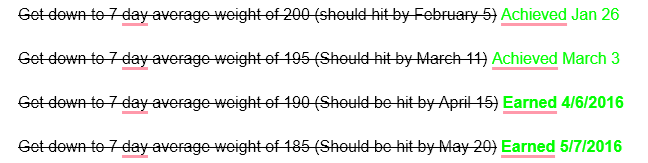
That worked for me because as I struck through each sub-goal I saw I was making progress.
Have you set your goal weight? If not, pick one that’s important to you. Not to your doctor. Not to your family. You. And then start tracking your progress in some visual format that works for you. You need a constant reminder in front of you that you are indeed making progress, because you are.
In addition, I highly recommend you set a step goal for yourself. A step goal is something you can control and can definitely do every day, no excuses. Walking around puts you in a better headspace and can crash that pity party you’ve been throwing yourself. (I, too, throw myself one from time to time, so don’t get down on yourself about that!)
5. Remember that your doctor works for you.
I understand that you’re feeling pressure right now from your doctor. But if you consistently work on your weight for the next 6 months, you will make progress, and I’m betting your doctor will be happy to see that. When you go to your next appointment, take your data with you. Show him that you’ve been tracking your weight. Show him you’re on a good trajectory, because you will be, provided you do not quit. But, here’s the thing. This is your life and your health we are talking about. You get to set the timelines, and ultimately anything you do or do not do is in your control. You are in the driver’s seat.
To that end, you must advocate for yourself at every appointment. The average visit is 15 minutes long, and many people get nervous and intimidated by the doctor. Miscommunication can happen all too easily. Write down things you want to discuss ahead of time. Ask questions and be honest. If something they recommend is something you disagree with, speak up. Ask about alternatives. And remember, you have options. Ultimately, you can get a second, third, or even fourth opinion if your doctor won’t listen, or if you do not feel comfortable with them for any reason. Doctors are human, and most get into medicine to help people. But there are bad apples in every bunch. Trust your intuition.
6. Connect with others.
You mentioned you’re all alone. You’re not alone. Many people are right where you are. Loads self-sabotage. I’ve been guilty of it far too many times! The good news is, there are plenty of us who have struggled with our weight, but we stopped quitting on ourselves, got the weight off, and have learned how to keep it off. (Despite the self-sabotage!)
Take proactive steps today to get yourself around like-minded people who want the best for you in your community. Go to church, or volunteer your time with a cause that means something to you. Severely limit your exposure to toxic people. (Read the book Boundaries if you have trouble telling people no.) Connection with others will help you avoid eating out of loneliness.
You can do this. Set your goal. Write down your plan. Track your weight. And every day, work you plan. If you fall 7 times, get up 8. You can do this. Just do not quit.
I wish you all the best!
Kayla